The number arrived quietly in my inbox this morning while I slept.
3:16 a.m. — No phone call. No preamble. Just a lab result waiting to be opened.
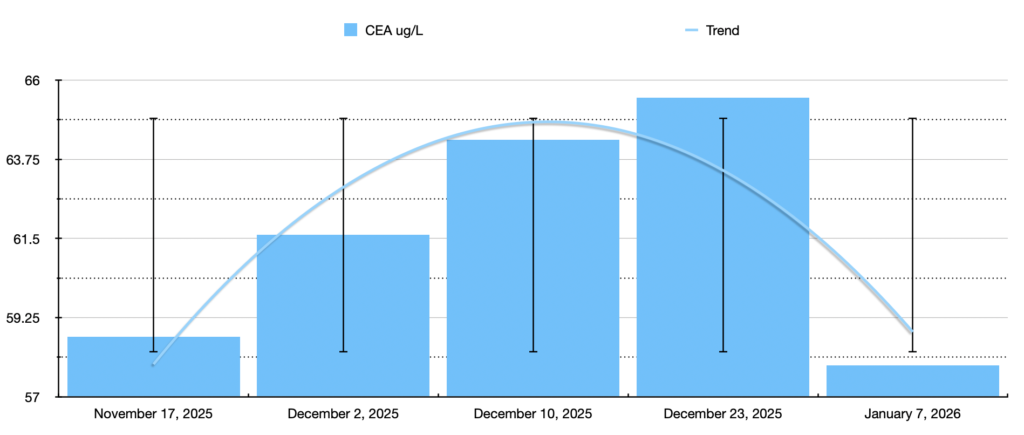
CEA: 57.9.
What is CEA?
CEA (Carcinoembryonic Antigen) is a protein that can be released into the bloodstream by certain cancers, including colorectal cancer. It’s not used to diagnose cancer on its own, but it can be useful for tracking trends over time.
Why it matters here:
For patients with metastatic colorectal cancer, changes in CEA can offer an early signal of how the disease is behaving—especially when interpreted alongside imaging and clinical findings. The direction of the curve matters more than any single number.
For the first time in months, the curve bent the other way.
I’ve written before about learning to read numbers without panic—about understanding that early treatment often looks like noise before it looks like signal. That was the posture I carried into this result as well. I wasn’t looking for a miracle. I was looking for direction.
And direction is what this offered.
Context Matters More Than the Number

On its own, a single CEA value doesn’t mean much. I’ve said that repeatedly, because it’s true. Tumour markers lag. They fluctuate. They rise during inflammation and stress. Early cycles of treatment often make them worse before they make them better.
But numbers don’t live alone. They live inside patterns.
Before treatment, my CEA was rising steadily. Not explosively, but unmistakably. That rise continued through the early days of the trial—exactly as expected. Then, sometime between the second and third infusions, the slope slowed. And now, for the first time, it reversed.
This isn’t proof. It isn’t a verdict. But it is a signal.
And it arrived at the precise moment when a signal becomes meaningful: just ahead of imaging and biopsy, designed to answer the real question—is this drug doing anything at all?
Holding Steady Long Enough for Change to Appear
Much of this phase has been about staying inside the window.
That’s what the quiet check-ins were about. That’s what reading lab abnormalities without spiralling was about. That’s what tolerating infusions, managing fatigue, eating with intent, and keeping my body moving have all been in service of.
You don’t get to evaluate effectiveness if you don’t remain eligible.
So far, I’ve stayed eligible.
Clinically, I’m still ECOG 0. My labs—while dotted with “abnormal” flags—tell a coherent story when read properly. Platelet dynamics adjusting. LDH reflecting metabolic activity. Calcium drifting slightly with hydration and fasting. PT/INR shifting in a liver that has already given up a significant portion of itself and is still doing the work asked of it.
None of those numbers has demanded intervention. They’ve demanded interpretation.
That discipline—learning what to watch and what to let pass—has been the real work of this chapter of my life, chapter 4 as I like to refer to it.
Why This Drop Matters Emotionally (Even If It Doesn’t Decide Anything)
I’ve written about purpose as a survival variable, and I stand by that framing. But purpose doesn’t eliminate uncertainty. It gives you something to stand on while uncertainty does its thing.
This CEA result didn’t change the plan. January 12 still matters. Imaging and biopsy will still decide whether I stay on this trial. Infusions continue as scheduled. The cadence holds.
But psychologically, this matters.
Not because it promises success—but because it suggests that the effort, the patience, the waiting, and the discipline might be interacting with something real on the other side.
When you live inside treatment, you don’t get many moments like that.
The Space Between Numbers and Proof
This is still the space between.
The space I’ve been writing about since before the first infusion. The space where nothing is declared and everything is observed. Where you resist the urge to narrate outcomes prematurely.
The numbers have slowed before. This time, they turned.
That doesn’t end the story. It sharpens it.
For now, I keep doing exactly what I’ve been doing:
- showing up for treatment
- reading signals without panic
- eating with structure
- moving my body
- planning my time intentionally
- waiting for proof without freezing
This is not resolution.
It’s alignment.
And sometimes, that’s enough to carry you to the next checkpoint.