I know better than to ride the numbers.
- I’ve written about this already — about curves, directionality, and why a single data point never tells the story. I’ve explained, carefully and calmly, why early treatment markers fluctuate, why noise masquerades as signal, and why interpretation requires time, not reaction.
- That thinking still holds.
- Nothing about the math has changed.
And yet, when the latest CEA came back up, I felt it anyway.

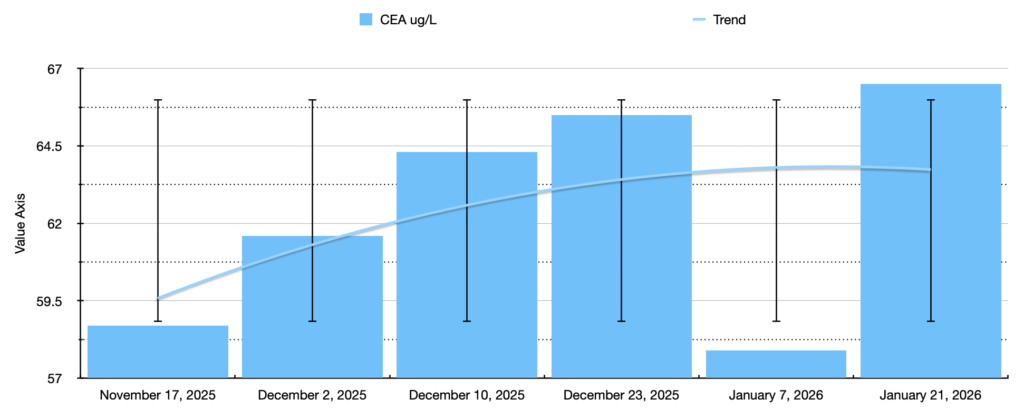
This is the part people don’t always admit: understanding the system does not grant immunity from the emotional reflex. Knowledge slows the fall, but it doesn’t eliminate the drop.
In When the Curve Changes Direction, I laid out the logic clearly — that what matters is slope, momentum, and consistency, not a single rise or fall. That post exists because I believe it. I still do. One data point does not undo a treatment strategy. One uptick does not equal failure. Early cycles are messy. Markers wobble. Biology is rarely polite.
But knowing that does not stop the momentary recalibration in your chest when a number goes the wrong way.
There’s a strange dissonance that sets in at this stage of treatment. You are no longer panicking — that phase passes quickly. You are also not naïve enough to expect linear improvement. What replaces those extremes is something quieter and harder to explain: vigilance without control.
- You watch.
- You wait.
- You tell yourself not to project meaning forward.
And still, hope sneaks in.
That’s the trap. Not hope as fantasy, but hope as pattern recognition. You see a dip, you think maybe — just maybe — the curve is turning. You remind yourself not to extrapolate, and yet part of your brain does it anyway. When the next number interrupts that narrative, the disappointment isn’t dramatic. It’s dull. Heavy. Brief. Then managed.
This is the emotional rollercoaster I know I’m not supposed to be on — not because it’s irrational, but because it’s unhelpful. It burns energy without changing outcomes. It pretends participation where there is none.
The discipline isn’t in pretending the feeling doesn’t exist. The discipline is in not letting it drive behaviour.
So I did what I always do: I zoomed back out.
The curve, taken as a whole, is still flat. There is no acceleration. No compounding rise. No confirmation of failure. The treatment hasn’t declared itself yet, one way or the other. This is still early. Still ambiguous. Still unresolved.
Which is uncomfortable — but not alarming.
The real work here isn’t endurance or bravery. It’s restraint. It’s resisting the urge to rewrite the story every two weeks. It’s allowing uncertainty to exist without filling it with meaning.
- I don’t need the numbers to cooperate today.
- I need them to reveal themselves over time.
And until they do, the only rational position is this:
- Pay attention.
- Stay steady.
- Don’t overinterpret.
I know better.